New publication by Karl Britto: ‘Madame, je ne suis pas une jeune fille’

In 1939, Phạm Duy Khiêm volunteered to enlist in the French army, the first and only Vietnamese colonial subject to do so. Before the war, he had studied in Paris at the Lycée Louis-le-Grand and the École normale supérieure, and had already begun to establish himself as an important francophone intellectual and writer. His military service was cut short by France’s surrender, but it nonetheless served as the basis for two autobiographical novels: La Place d’un homme, published soon after the author’s return to colonial Indochina in 1941, and De La Courtine à Vichy, a sequel that was censored by the Vichy regime and that remains unpublished today. While the first text is characterized by the narrator’s sense of honour in defending apparently universal ideals, the sequel is infused with disillusionment and even contempt in the face of French collaboration. Through an analysis of key moments at which race and gender intersect in these texts, this article argues that the narrator’s decision to volunteer reflects a desire for dissolution into an abstract ideal of universal humanity, but that this desire eventually gives way to a form of ambiguous masculinity open to identification with the feminine. 

Read the article: Karl Britto: “‘Madame, je ne suis pas une fille’: Phạm Duy Khiêm’s La Place d’un homme

Image: Phạm Duy Khiêm/Editions PLON 

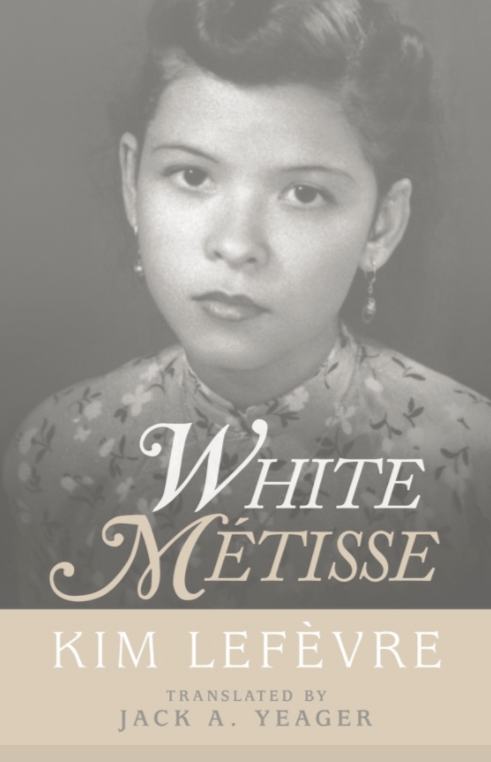
Recent publication by Jack Yeager: Kim Lefèvre’s White Métisse

In this evocative memoir, Kim Lefèvre recounts her childhood and adolescence growing up in colonial Viet Nam. As a little girl living with her Vietnamese mother, she doesn’t understand the reactions of others toward her, their open mistrust, contempt, and rejection. Though she feels no different from those around her, she comes to understand that to Vietnamese she is living proof of her mother’s moral downfall, a constant and unwelcome reminder of a child conceived with a French soldier out of wedlock. As anticolonial sentiment grows in an atmosphere of rising nationalism, Lefèvre’s situation becomes increasingly precarious.  

Set within a tumultuous period of Franco-Vietnamese history—resistance and revolt, World War II and the Japanese invasion, the first war for independence against the French—White Métisse offers a unique view of watershed events and provides insights into the impact of upheaval and open conflict on families and individuals. Lefèvre’s story captures the instability and daily humiliations of her life and those of other marginalized members of society. Sent by her mother to live with distant family members who view her variously as ungrateful, a bad seed, or “neither gold nor silver,” she is later abandoned in an orphanage with other métissegirls. Lefèvre’s discovery of her own sexuality is overshadowed by her mother’s concerned advice to not repeat the same mistakes she had made, reminding her daughter of the Vietnamese social mores that condemn her very existence. Eventually the challenge and solace of education lead to a scholarship to study in Paris and Lefèvre departs Viet Nam for a new life in France in 1960.  

Part personal memoir, part coming of age story, Lefèvre’s moving account shows the courage and strength of an individual who is able to embrace her hybrid identity and gain self-esteem on her own terms despite living between worlds. White Métisse has been in print in France since its appearance in 1989 and continues to resonate strongly in the universal contexts of immigration, shifting cultural identities, rejection, and assimilation. Now Jack A. Yeager’s elegant translation makes Kim Lefèvre’s compelling memoir available to English-speaking readers. 

Find the book

Read a review of the book

Image: Kim Lefèvre/University of Hawai’i Press 

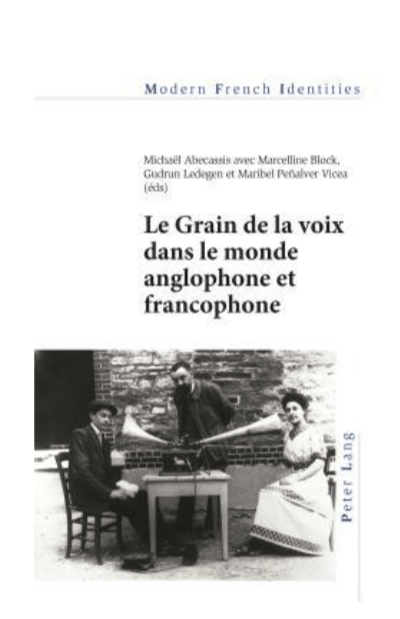
Alexandra Kurmann and Tess Do contribute to Modern French Identities series

Alexandra Kurmann and Tess Do contributed themed bio-bibliographical vignettes on the Vietnamese-Francophone writers Linda Lê, Anna Moï and Kim Lefèvre to the encyclopaedic edited volume on modern cultural production entitled Le grain de la voix dans le monde anglophone et francophone, whose title alludes to interviews with the theorist, Roland Barthes. The contributions allow for Vietnamese Diaspora writers’ voices and their diverse timbres to be recognised and heard alongside their artistic contemporaries. In particular, the vignettes reveal respectively the liminal, multidisciplinary, and translational qualities of the literary voices of these Francophone women writers. 

Link to the book

Image: Bibliothèque Nationale de France/Peter Lang 

New publication by Leslie Barnes: Nicholas Kristof as Global Savior

In his forward to Somaly Mam’s The Road of Lost Innocence, Nicholas Kristof celebrates the Cambodian sex-trafficking survivor for embodying “the resilience, courage, and nobility of the human spirit.” Kristof, a journalist for The New York Times, was among Mam’s most enthusiastic champions until an article published in Newsweek in 2014 challenged the veracity of her testimony. And in his writing about sexual servitude in Cambodia, he has played a significant role in defining sex trafficking on the global stage. Kristof’s mediation has taken several forms. He has penned numerous editorial pieces about sexual violence toward women around the world; created a “trans-media project,” called Half the Sky, aiming to “put an end to the oppression of women and girls worldwide…”; documented in his NYT column his interactions with two Cambodian sex workers whose freedom he purchased in 2004; and in 2011, live-tweeted a brothel raid orchestrated by Mam.

In this essay, I situate Kristof’s narrativeself-fashioningin the context of the neoimperialist rescue fantasies his writing perpetuates. I explore the intersections between Kristof’s writing and the various media he employs, and interrogate the effects of both on the audience he wishes to interpellate in the name of action. I am interested in the tensions created in Kristof’s texts, and in particular, the ways in which the Twitter episode suspends the implied witness somewhere between the immediacy of what Craig Calhoun calls the “emergency imaginary” and the physical and temporal remove of Luc Boltanski’s “distant suffering.” In his writings, Kristof constructs and disseminates a set of claims about the truth of sex trafficking, presents himself as a global savior figure, and encourages the “ironic” participation of his witness, who is moved less to take part in a cosmopolitan morality centered on justice for the Other than to identify with the celebrity/savior figure and to contemplate his or her own narcissistic performance of solidarity.

Read the article: Leslie Barnes, “Live-Tweeting and Distant Suffering: Nicholas Kristof as Global Savior”